
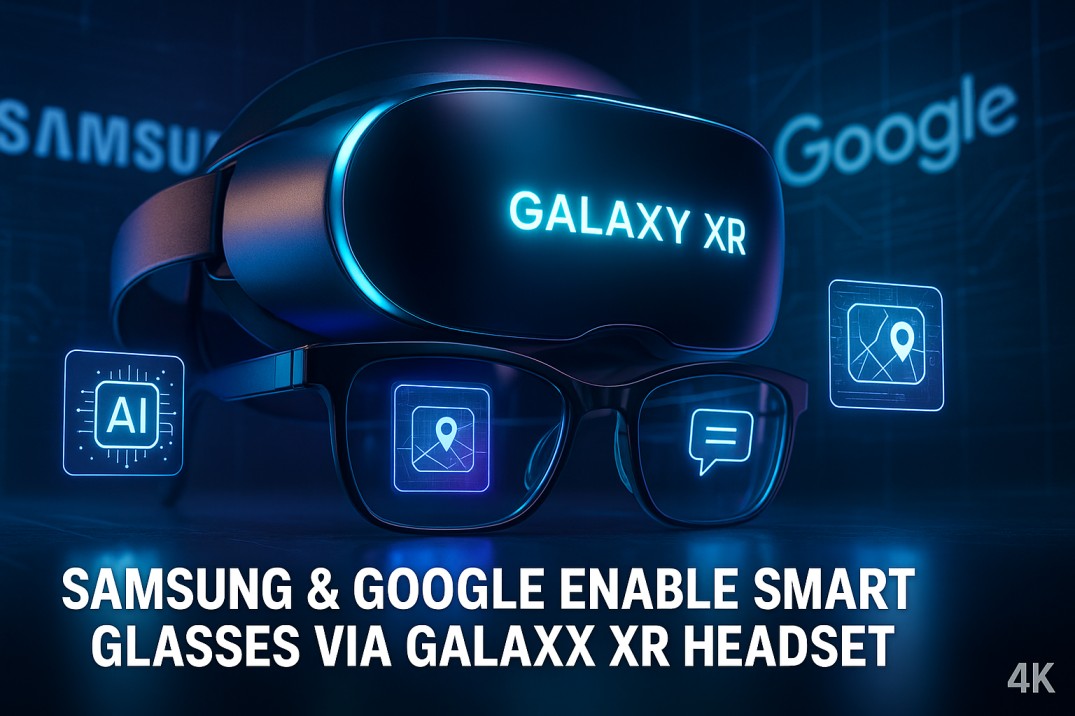
Future smart glasses are made possible by Samsung and Google’s new Galaxy XR headset.
With the launching of their new Android XR operating system, Samsung (005930.KS) and Google (GOOG, GOOGL) are targeting Meta (META) and the smart glasses industry. Android XR, which was co-developed with Qualcomm (QCOM), is intended to power gadgets that range from extended reality headsets to smart glasses that are loaded with Google’s Gemini AI assistant.
Samsung’s latest mixed reality headset, the Galaxy XR, comes first. The Galaxy XR, which retails for $1,799 starting today, is comparable to Apple’s (AAPL) Vision Pro and Meta’s Quest 3 in that it completely fills your field of vision while offering passthrough vision through its integrated external cameras.
It has built-in eye-tracking cameras for navigation, just like the Vision Pro. Additionally, external cameras and sensors record your hand movements, enabling you to pinch to grab different virtual windows and apps and navigate the interface.
Even though the technology of the Galaxy XR is very similar to that of the headsets made by Apple and Meta, Samsung and Google are relying on their Android XR and Google’s Gemini to be the main differentiators for their devices.
However, persuading Samsung, Google, and Qualcomm to collaborate wasn’t always simple, according to Won-Joon Choi, COO of Samsung’s mobile experience division.
While working with three different companies to develop the headset’s hardware and software, Choi told Yahoo Finance, “At first, it was not easy at all.”
“I understand that some might wonder, ‘Why are you guys getting into this market… while the other businesses are struggling?'” Choi stated. “We think the answer is that we kind of saw the synergy between the two when you combine this XR with [Gemini’s] multimodal AI.”
Gemini allows you to ask the Galaxy XR questions about what you’re viewing through onscreen windows or passthrough in real life. In one demonstration, a Samsung official asked Gemini to show them pizza places in a specific area after bringing up Google Maps. After that, the headset identified the one with the most reviews and provided details about it.
In another, Gemini was questioned about a pair of glasses that the Samsung representative was holding by a Google person who was using a headset. The headset swiftly brought up the Gentle Monster website after utilizing passthrough to analyze the glasses and determine that they were made by the company.
However, Google and Samsung are not the only companies that include AI into their headsets. Apple’s Vision Pro is expected to receive the company’s AI-powered Siri when the software is released, and Meta employs its Meta AI in its Quest 3.
Additionally, the Galaxy XR headsets aren’t very popular. The market leader, Meta, reported an 11% quarter-over-quarter drop in headset shipments to 710,000 units in Q2, according to CounterPoint Research.
However, according to the research agency, shipments of augmented reality smart glasses rose 74% globally year over year.
And Google and Samsung are moving in that direction. Choi claims that the Galaxy XR establishes the groundwork for the company’s upcoming gadgets. According to Samsung, this would initially comprise wired smart glasses, followed by wireless smart glasses, and finally, artificial intelligence glasses. These will probably have a built-in display of some sort to show programs like Google Maps for on-screen navigation or chat apps.
Google and Samsung will have a difficult time competing. Meta already sells its well-liked Ray-Ban Meta smart spectacles in addition to its Quest 3 headset. Additionally, the business recently unveiled their Meta Ray-Ban Display spectacles, which come with a built-in display and a Neural Band that can be worn on the wrist and uses hand gestures to interface with apps.
Mark Gurman of Bloomberg claims that in addition to Samsung, Google, and Qualcomm, Apple is also developing its own line of smart glasses.
For more information about Samsung & Google, visit our site Tech Nova and explore expert insights and solutions.